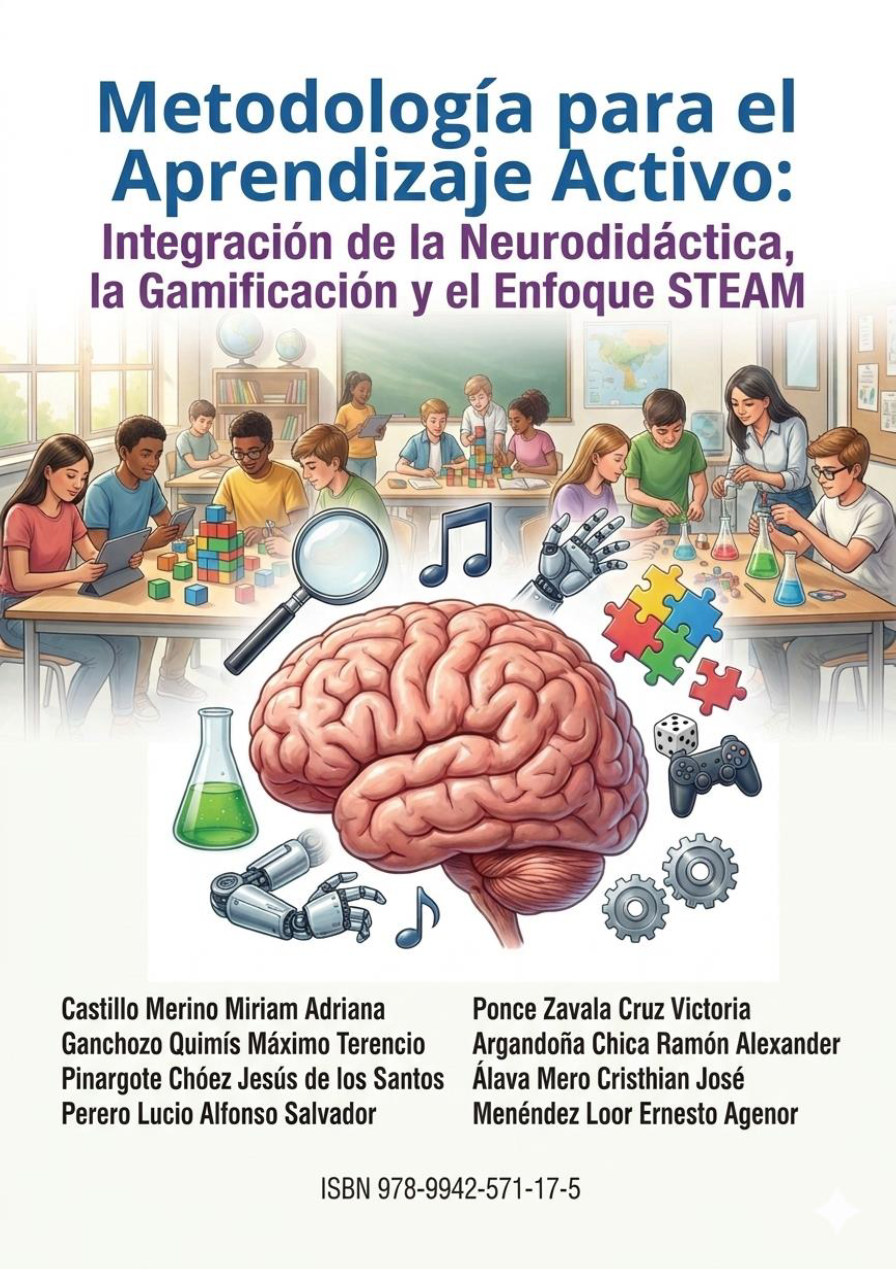
Metodología para el Aprendizaje Activo: Integración de la Neurodidáctica, la Gamificación y el Enfoque STEAM
ISBN: 978-9942-571-17-5
Keywords:
aprendizaje activo; neurodidáctica; gamificación; enfoque STEAM; innovación educativaAbstract
El libro Metodología para el Aprendizaje Activo: Integración de la Neurodidáctica, la Gamificación y el Enfoque STEAM constituye una propuesta académica orientada a la transformación de los procesos educativos mediante la articulación coherente entre fundamentos neurocientíficos, estrategias lúdicas y enfoque interdisciplinario STEAM. La obra desarrolla un marco teórico y metodológico que transita desde la enseñanza tradicional hacia modelos centrados en la experiencia, la participación activa y la construcción significativa del conocimiento. A lo largo de sus capítulos se analizan las bases neurobiológicas del aprendizaje, la función de la emoción en la consolidación cognitiva, la plasticidad cerebral y la relevancia de la retroalimentación formativa. También se analizan los principios psicológicos y educativos de la gamificación, subrayando su papel en el aumento de la motivación interna, el pensamiento creativo y la colaboración en la solución de problemas. El enfoque STEAM se presenta como una arquitectura curricular que integra ciencia, tecnología, ingeniería, arte y matemáticas, promoviendo competencias orientadas a la innovación responsable y al compromiso social. La obra incorpora modelos de diseño instruccional, estrategias multisensoriales, evaluación basada en evidencias y uso de tecnologías emergentes, incluyendo inteligencia artificial y entornos inmersivos. Además, se desarrollan experiencias aplicadas en educación superior que evidencian la viabilidad de estas metodologías en escenarios reales. El texto ofrece una contribución clara y organizada que combina teoría, práctica y evidencia científica para mejorar la formación integral del estudiante en las escuelas de hoy.
Palabras clave: aprendizaje activo; neurodidáctica; gamificación; enfoque STEAM; innovación educativa.
Downloads
References
Abrami, P. C., Bernard, R. M., Borokhovski, E., Waddington, D., Wade, C. A., & Persson, T. (2015). Strategies for teaching students to think critically. Review of Educational Research, 85(2), 275–314. https://doi.org/10.3102/0034654314551063
Ambrose, S. A., Bridges, M. W., DiPietro, M., Lovett, M. C., & Norman, M. K. (2017). How learning works: Seven research-based principles for smart teaching (2nd ed.). Jossey-Bass.
Barría-Pineda, J., Guerra, J., & Scheihing, E. (2021). Learning analytics to improve gamified educational environments. IEEE Revista Iberoamericana de Tecnologías del Aprendizaje, 16(3), 234–241.
Barrows, H. S., & Tamblyn, R. M. (1980). Problem-based learning: An approach to medical education. Springer.
Beaty, R. E., Benedek, M., Silvia, P. J., & Schacter, D. L. (2016). Creative cognition and brain network dynamics. Trends in Cognitive Sciences, 20(2), 87–95. https://doi.org/10.1016/j.tics.2015.10.004
Bergmann, J., & Sams, A. (2016). Flipped learning for elementary instruction. International Society for Technology in Education.
Biesta, G. (2015). What is education for? On good education, teacher judgement, and educational professionalism. European Journal of Education, 50(1), 75–87. https://doi.org/10.1111/ejed.12109
Biggs, J., & Tang, C. (2011). Teaching for quality learning at university (4th ed.). Open University Press.
Black, P., & Wiliam, D. (2018). Classroom assessment and pedagogy. Assessment in Education: Principles, Policy & Practice, 25(6), 551–575. https://doi.org/10.1080/0969594X.2018.1441807
Bronfenbrenner, U. (1994). Ecological models of human development. In T. Husen & T. N. Postlethwaite (Eds.), International Encyclopedia of Education (2nd ed.). Elsevier.
Brookhart, S. M. (2018). How to create and use rubrics for formative assessment and grading. ASCD.
Brown, T. (2019). Change by design: How design thinking transforms organizations and inspires innovation (Rev. ed.). Harper Business.
Bruner, J. (1996). The culture of education. Harvard University Press.
Bybee, R. W. (2013). The case for STEM education: Challenges and opportunities. NSTA Press.
Carvajal-Rivadeneira, D. D., Guaranda-Mero, B. G., & Domínguez-Gálvez, D. L. (2024). Aplicación de la inteligencia artificial en proyectos de ingeniería civil. Revista Científica INGENIAR: Ingeniería, Tecnología e Investigación.
CAST. (2018). Universal Design for Learning Guidelines version 2.2. CAST.
CEPAL. (2022). La transformación digital en América Latina. Comisión Económica para América Latina y el Caribe.
Choez, J. S. P., Menoscal, R. M. P., Merino, M. A. C., Rodríguez, J. C. G., & Chele, M. Á. C. (2025). La metodología STEAM y la inteligencia artificial en la educación. Editorial Internacional Runaiki.
Condliffe, B., Quint, J., Visher, M. G., Bangser, M. R., Drohojowska, S., & Saco, L. (2017). Project-based learning: A literature review. MDRC.
Csikszentmihalyi, M. (2014). Flow and the foundations of positive psychology. Springer.
Daniels, H. (2016). Vygotsky and pedagogy (2nd ed.). Routledge.
Darling-Hammond, L., Flook, L., Cook-Harvey, C., Barron, B., & Osher, D. (2020). Implications for educational practice of the science of learning and development. Applied Developmental Science, 24(2), 97–140. https://doi.org/10.1080/10888691.2018.1537791
Deci, E. L., Koestner, R., & Ryan, R. M. (2017). Extrinsic rewards and intrinsic motivation in education. Educational Psychologist, 52(1), 1–16.
Dede, C. (2014). The role of immersive media in online education. Journal of Online Learning and Teaching, 10(4), 657–668.
Deterding, S., Dixon, D., Khaled, R., & Nacke, L. (2011). From game design elements to gamefulness. Proceedings of the 15th International Academic MindTrek Conference, 9–15.
Diamond, A., & Ling, D. S. (2016). Conclusions about interventions and approaches for improving executive functions. Developmental Cognitive Neuroscience, 18, 34–48. https://doi.org/10.1016/j.dcn.2015.11.005
Dichev, C., & Dicheva, D. (2020). Gamifying education: What is known, what is believed and what remains uncertain. International Journal of Educational Technology in Higher Education, 17(9). https://doi.org/10.1186/s41239-020-00211-0
Draganski, B., Gaser, C., Busch, V., Schuierer, G., Bogdahn, U., & May, A. (2004). Neuroplasticity: Changes in grey matter induced by training. Nature, 427, 311–312.
Dunlosky, J., Rawson, K. A., Marsh, E. J., Nathan, M. J., & Willingham, D. T. (2013). Improving students’ learning with effective learning techniques. Psychological Science in the Public Interest, 14(1), 4–58. https://doi.org/10.1177/1529100612453266
Durlak, J. A., Weissberg, R. P., Dymnicki, A. B., Taylor, R. D., & Schellinger, K. B. (2017). The impact of enhancing students’ social and emotional learning: A meta-analysis. Child Development, 88(4), 1156–1171.
Dweck, C. S. (2017). Mindset: Changing the way you think to fulfil your potential. Robinson.
Fields, R. D. (2015). A new mechanism of nervous system plasticity: Activity-dependent myelination. Nature Reviews Neuroscience, 16(12), 756–767. https://doi.org/10.1038/nrn4023
Freeman, S., Eddy, S. L., McDonough, M., Smith, M. K., Okoroafor, N., Jordt, H., & Wenderoth, M. P. (2014). Active learning increases student performance in science, engineering, and mathematics. Proceedings of the National Academy of Sciences, 111(23), 8410–8415. https://doi.org/10.1073/pnas.1319030111
Freire, P. (1970). Pedagogy of the oppressed. Continuum.
Fullan, M. (2016). The new meaning of educational change (5th ed.). Teachers College Press.
González, C., Toledo, P., & Muñoz, V. (2021). Gamification for students with attention difficulties: Effects on engagement and task persistence. Computers & Education, 172, 104262.
Green, M. C., & Brock, T. C. (2000). The role of transportation in narrative persuasion. Journal of Personality and Social Psychology, 79(5), 701–721.
Gruber, M. J., & Ranganath, C. (2019). How curiosity enhances hippocampus-dependent memory: The prediction, appraisal, curiosity, and exploration (PACE) framework. Trends in Cognitive Sciences, 23(12), 1014–1025. https://doi.org/10.1016/j.tics.2019.10.003
Published
How to Cite
Issue
Section
Copyright (c) 2026 EDITORIAL INTERNACIONAL RUNAIKI

This work is licensed under a Creative Commons Attribution-NonCommercial-ShareAlike 4.0 International License.