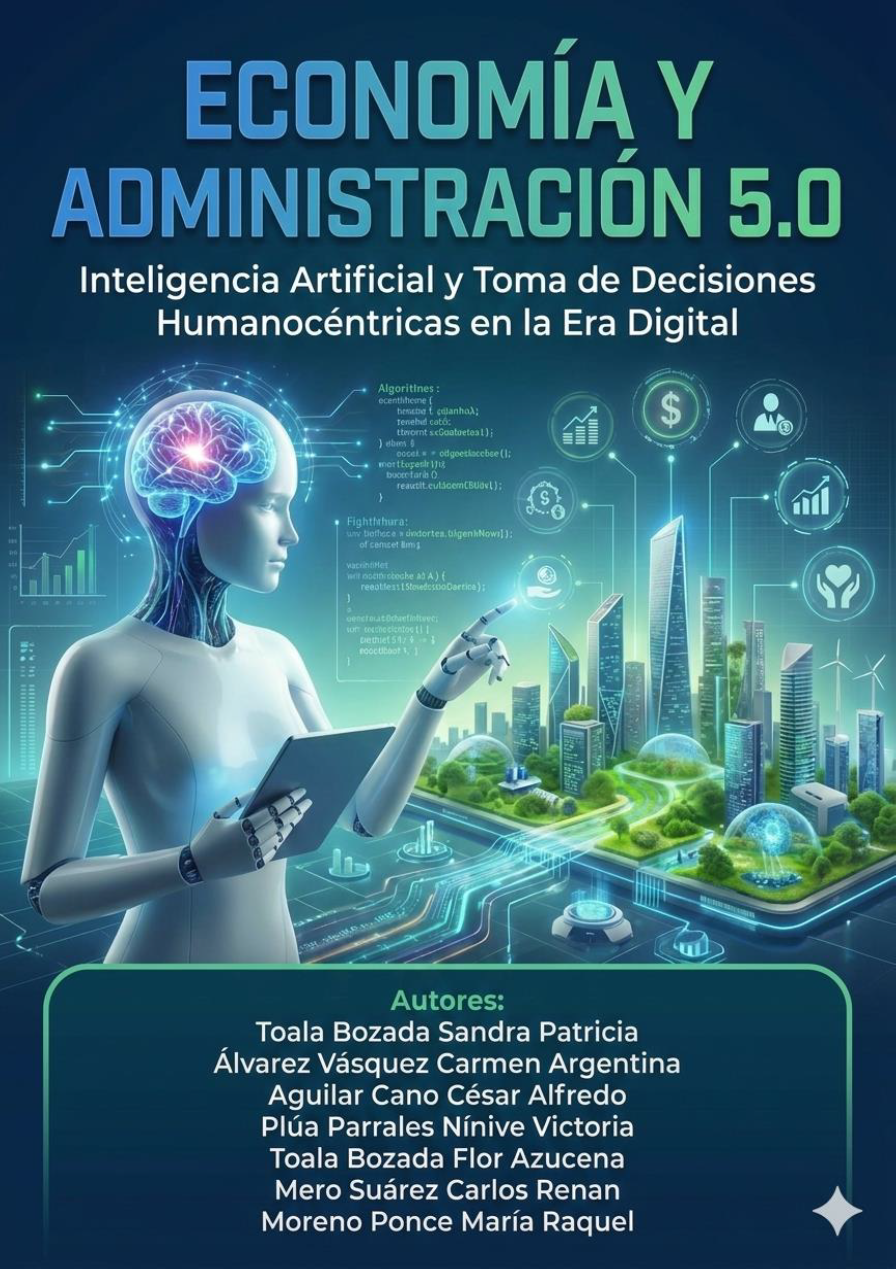
Economía y Administración 5.0: Inteligencia Artificial y Toma de Decisiones Humanocéntricas en la Era Digital
ISBN: 978-9942-571-18-2
Palabras clave:
Administración 5.0; inteligencia artificial; gobernanza algorítmica; transformación digital; alfabetización digital.Resumen
Este trabajo presenta una idea tanto teórica como práctica sobre la Economía y la Administración 5.0. Estos conceptos se ven como marcos que combinan inteligencia artificial, análisis de datos, automatización inteligente y una buena gobernanza en entornos empresariales y educativos que usan tecnología digital.El contenido aborda la transición desde modelos productivos tradicionales hacia estructuras basadas en datos, donde algoritmos, plataformas digitales, Internet de las cosas y blockchain reconfiguran procesos de asignación de recursos, cadenas de suministro, personalización de servicios y toma de decisiones estratégicas. Se estudia cómo la inteligencia artificial afecta la productividad global, los cambios en el empleo y la relación entre humanos y algoritmos. Se resalta la importancia de tener reglas de gobernanza flexibles, una cultura organizacional basada en datos y un liderazgo ético en la era de los algoritmos. Asimismo, se exponen los fundamentos pedagógicos de la alfabetización digital, el aprendizaje personalizado, la evaluación formativa inteligente y los laboratorios virtuales como componentes esenciales para formar talento aumentado en contextos de economía inteligente. El enfoque centrado en las personas de la Administración 5.0 busca equilibrar la eficiencia tecnológica con la responsabilidad social, el cuidado del medio ambiente y el desarrollo completo de las personas. Favorece modelos de innovación abierta, colaboración entre instituciones y evaluación constante. En conjunto, el libro ofrece una visión sistémica donde la tecnología no actúa como fin en sí misma, sino como instrumento estratégico para fortalecer competitividad, resiliencia y equidad en entornos organizacionales y educativos altamente digitalizados.
Palabras clave: Administración 5.0; inteligencia artificial; gobernanza algorítmica; transformación digital; alfabetización digital.
Descargas
Citas
Acemoglu, D., & Restrepo, P. (2020). Robots and jobs: Evidence from US labor markets. Journal of Political Economy, 128(6), 2188–2244. https://doi.org/10.1086/705716
Aghion, P., Antonin, C., & Bunel, S. (2021). The power of creative destruction: Economic upheaval and the wealth of nations. Harvard University Press.
Agudelo, L. H., Jóhannesson, G., & Sørensen, A. (2021). Digital industries and economic development in Latin America (CAF Working Paper No. 2021/07). Banco de Desarrollo de América Latina. https://scioteca.caf.com/handle/123456789/1766
Athey, S., & Imbens, G. (2019). Machine learning methods that economists should know about. Annual Review of Economics, 11, 685–725. https://doi.org/10.1146/annurev-economics-080217-053433
Autor, D. (2022). The labor market impacts of technological change. NBER Working Paper. National Bureau of Economic Research.
Avolio, B. J., Sosik, J. J., Kahai, S. S., & Baker, B. (2014). E-leadership: Reexamining transformations in leadership source and transmission. The Leadership Quarterly, 25(1), 105–131. https://doi.org/10.1016/j.leaqua.2013.11.003
Barocas, S., Hardt, M., & Narayanan, A. (2019). Fairness and machine learning: Limitations and opportunities. MIT Press.
Bi, K., Yang, C., Huang, P., & Zhang, J. (2025). Digital economy and industrial structure transformation: Evidence from China. Economic Modelling, 131, 106512. https://doi.org/10.1016/j.econmod.2024.106512
Brynjolfsson, E., & McAfee, A. (2014). The second machine age: Work, progress, and prosperity in a time of brilliant technologies. W. W. Norton & Company.
Brynjolfsson, E., & McAfee, A. (2019). The second machine age. W. W. Norton & Company.
Brynjolfsson, E., Collis, A., & Eggers, F. (2019). Using massive online choice experiments to measure changes in well-being. Proceedings of the National Academy of Sciences, 116(15), 7250–7255. https://doi.org/10.1073/pnas.1815663116
Brynjolfsson, E., Rock, D., & Syverson, C. (2021). The productivity J-curve: How intangibles complement general purpose technologies. American Economic Journal: Macroeconomics, 13(1), 333–372. https://doi.org/10.1257/mac.20180386
Cabinet Office of Japan. (2020). Society 5.0: For human-centered society. Government of Japan.
Castells, M. (2018). The rise of the network society (2nd ed.). Wiley-Blackwell.
CEPAL. (2023). Transformación digital y desarrollo productivo en América Latina. Comisión Económica para América Latina y el Caribe.
Chang, Y. (2024). Digital economy development and industrial structure upgrading: Empirical evidence from China. Sustainability, 16(8), 3451. https://doi.org/10.3390/su16083451
Chernozhukov, V., Chetverikov, D., Demirer, M., et al. (2018). Double/debiased machine learning for treatment and structural parameters. The Econometrics Journal, 21(1), C1–C68. https://doi.org/10.1111/ectj.12097
Corrado, C., Haskel, J., & Jona-Lasinio, C. (2022). Intangible capital and growth. Oxford Review of Economic Policy, 38(1), 1–26. https://doi.org/10.1093/oxrep/grab038
Crémer, J., de Montjoye, Y. A., & Schweitzer, H. (2019). Competition policy for the digital era. European Commission.
Davenport, T. H., & Ronanki, R. (2018). Artificial intelligence for the real world. Harvard Business Review, 96(1), 108–116.
De Caigny, A., Coussement, K., & De Bock, K. W. (2021). Uplift modeling and its implications for B2B customer churn prediction: A segmentation-based modeling approach. International Journal of Research in Marketing.
De León Nazareno, J. A. (2024). Transformación digital y productividad empresarial: Un análisis desde la automatización de procesos. Revista Cubana de Economía y Planificación, 30(2), 45–62. https://scielo.sld.cu/scielo.php?script=sci_arttext&pid=S0252-85842024000200014
European Central Bank. (2024). Digitalisation, productivity and firm performance in the euro area (Occasional Paper No. 339). European Central.
European Commission. (2019). Ethics guidelines for trustworthy AI. Publications Office of the European Union.
European Commission. (2022). Digital skills and jobs action plan. Publications Office of the European Union.
European Commission. (2022). Human-centric digital transformation. Publications Office of the European Union.
European Commission. (2023). Digital Economy and Society Index (DESI) 2023. Publications Office of the European Union.
Frank, A. G., Dalenogare, L. S., & Ayala, N. F. (2019). Industry 4.0 technologies: Implementation patterns in manufacturing companies. International Journal of Production Economics, 210, 15–26. https://doi.org/10.1016/j.ijpe.2019.01.004
Fuster, A., Plosser, M., Schnabl, P., & Vickery, J. (2019). The role of technology in mortgage lending. The Review of Financial Studies, 32(5), 1854–1899. https://doi.org/10.1093/rfs/hhz018
Goldfarb, A., & Tucker, C. (2019). Digital economics. Journal of Economic Literature, 57(1), 3–43. https://doi.org/10.1257/jel.20171452
Goleman, D. (2017). Leadership that gets results. Harvard Business Review Press.
Gubela, R. M., Lessmann, S., & Seow, H.-V. (2021). Uplift modeling with value-driven evaluation metrics. Decision Support Systems.
International Labour Organization. (2021). World employment and social outlook: The role of digital labour platforms. ILO.
International Monetary Fund. (2024). Artificial intelligence and the future of work. IMF.
Li, D., Raymond, L., & Bergman, P. (2025). Hiring as exploration. The Review of Economic Studies.
Mullainathan, S., & Spiess, J. (2017). Machine learning: An applied econometric approach. Journal of Economic Perspectives, 31(2), 87–106. https://doi.org/10.1257/jep.31.2.87
Mullainathan, S., & Spiess, J. (2017). Machine learning: An applied econometric approach. Journal of Economic Perspectives, 31(2), 87–106. https://doi.org/10.1257/jep.31.2.87
Publicado
Cómo citar
Número
Sección
Derechos de autor 2026 EDITORIAL INTERNACIONAL RUNAIKI

Esta obra está bajo una licencia internacional Creative Commons Atribución-NoComercial-CompartirIgual 4.0.